
Conservation of the Hawksbill Sea Turtle: An Overview of Critically Endangered Species
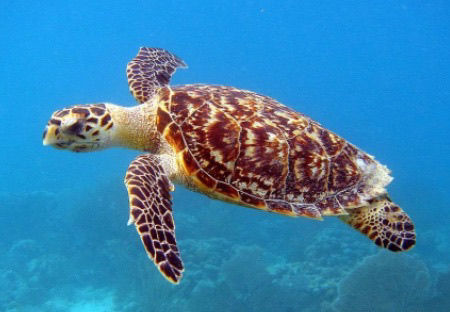
The hawksbill sea turtle (Eretmochelys imbricata) is a marine species distinguished by its unique physical characteristics. Its shell features serrated edges and overlapping scutes, consisting of five central scutes and four pairs of lateral scutes, with coloration ranging from amber, orange, and red to yellow, black, and brown. Furthermore, its V-shaped jaw and narrow head, resembling a hawk’s beak, are other remarkable features (OLIVEIRA et al., 2012). Its portuguese common name derives from the historical use of its shell in the manufacture of combs. Additionally, this species is depicted on the Brazilian R$2.00 banknote!
This species is distributed throughout the tropical and subtropical waters of the Atlantic, Indian, and Pacific Oceans. In Brazil, it nests primarily along the northern coast of Bahia, Sergipe, and the southern coast of Rio Grande do Norte, where a single female may lay approximately 2,200 eggs per breeding season (OLIVEIRA et al., 2012; SILVA et al., 2017). Its preferred habitat includes coral reefs and rocky shores in shallow coastal waters. The hawksbill sea turtle exhibits a diverse diet, feeding mainly on sponges, as well as sea anemones, soft corals, sea urchins, jellyfish, squid, and shrimp (OLIVERIDLEYPROJECT, n.d.).
Also referred to as the “true turtle” in Brazil, this species plays an essential role in marine ecosystems, particularly in coral reefs, where it acts as a natural regulator of sponge populations and other benthic invertebrates (OLIVEIRA et al., 2012). This ecological function directly contributes to the health and balance of these habitats, protecting biodiversity and ensuring the maintenance of ecosystem services provided by coral reefs, such as coastal protection and support for local fisheries (SILVA et al., 2017).
Nevertheless, despite its wide distribution, the hawksbill sea turtle is currently classified as “Critically Endangered” by the International Union for Conservation of Nature due to illegal hunting driven by demand for its shell, which is used by artisans in the production of jewelry and decorative artifacts (PROJETO TAMAR, n.d.; SILVA et al., 2017). To combat this threat, the Convention on International Trade in Endangered Species of Wild Fauna and Flora prohibits the international trade of products derived from this species. Institutions such as NOAA Fisheries work toward the protection and recovery of global populations (NOAA FISHERIES, n.d.). In Brazil, Projeto Tamar develops monitoring, cataloguing, and protection initiatives for the hawksbill sea turtle and other marine species (PROJETO TAMAR, n.d.).
To ensure the long-term survival of E. imbricata, it is essential to strengthen and expand these initiatives by combining scientific research with the involvement of local communities and public policies that promote marine conservation. Only through a collective and multidisciplinary commitment will it be possible to reverse the current population decline and ensure that future generations may continue to appreciate and learn from the rich biodiversity represented by this emblematic marine turtle.
Author: Maria Eduarda Panisson Balzan –
Regional Representative of GEAS Brasil Review: Iago Junqueira - Partner of GEAS Brasil via The Wild Place
May/2026 Wildlife Panel
References
ASSOCIAÇÃO BRASILEIRA DE PESQUISA E CONSERVAÇÃO DE TARTARUGAS MARINHAS – Projeto Tamar. Tartaruga de pente. Disponível em: https://www.tamar.org.br/tartaruga.php?cod=19.
INSTITUTO NACIONAL DE PESCA E PESQUERIAS OCEÂNICAS – NOAA Fisheries. Hawksbill Turtle. Disponível em:
OLIVERIDLEYPROJECT. Hawksbill turtle diet and characteristics. Disponível em: https://oliveridleyproject-org.translate.goog/sea-turtles-of-the-world/hawksbill turtle/?_x_tr_sl=en&_x_tr_tl=pt&_x_tr_hl=pt&_x_tr_pto=rq.
OLIVEIRA, J. A.; et al. Tartarugas de pente (Eretmochelys imbricata) no litoral sul do Rio Grande do Norte. 2012. Disponível em:
https://d1wqtxts1xzle7.cloudfront.net/43986917/2012_Tartarugas_de_pente_Ei_no_lito ral_sul_do_Rio_Grande_do_Norte-libre.pdf?1458648660=.
SILVA, M. R. et al. Conservação e manejo das tartarugas marinhas. Anais do Congresso de Educação. 2017. Disponível em:
https://www.editorarealize.com.br/editora/anais/conedu/2017/TRABALHO_EV073_M D4_SA14_ID320_16102017174216.pdf.


Comments